How Can You Tell If a Tree Is Dangerous?
Most trees are perfectly safe, but a few visible warning signs can indicate a tree needs a closer look. Here's what to watch for, and how a proper risk assessment actually works.

A Sudden Lean
A tree that has developed a new lean — particularly one that's appeared quickly rather than always having grown that way — can indicate the root system has moved. Lifting or cracked ground on the opposite side to the lean is often the giveaway, as the root plate begins to pull out of the soil.
A tree that has always leaned is a different matter. Trees grow towards light and away from competition, and a long-standing lean with no ground disturbance is usually just the shape the tree has made for itself.
Large Cracks or Splits
Cracks or splits in the trunk or in major branches can be a sign the tree is beginning to fail structurally. This doesn't mean every crack is an emergency, but it's the kind of thing worth having looked at rather than left.
Pay particular attention to the point where two stems meet. A narrow, V-shaped union with bark pinched inside it — included bark — is structurally weaker than a wide, open U-shaped union, and it's one of the more common failure points on mature garden trees.
Large Dead Branches
Dead wood can fall with very little warning, because it doesn't have the flexibility of living wood to bend under load. The strength of dead wood generally only gets worse the longer it's left, although this varies between species. A large dead branch over a driveway, path, or anywhere people spend time is worth prioritising.
Fungi at the Base of the Tree
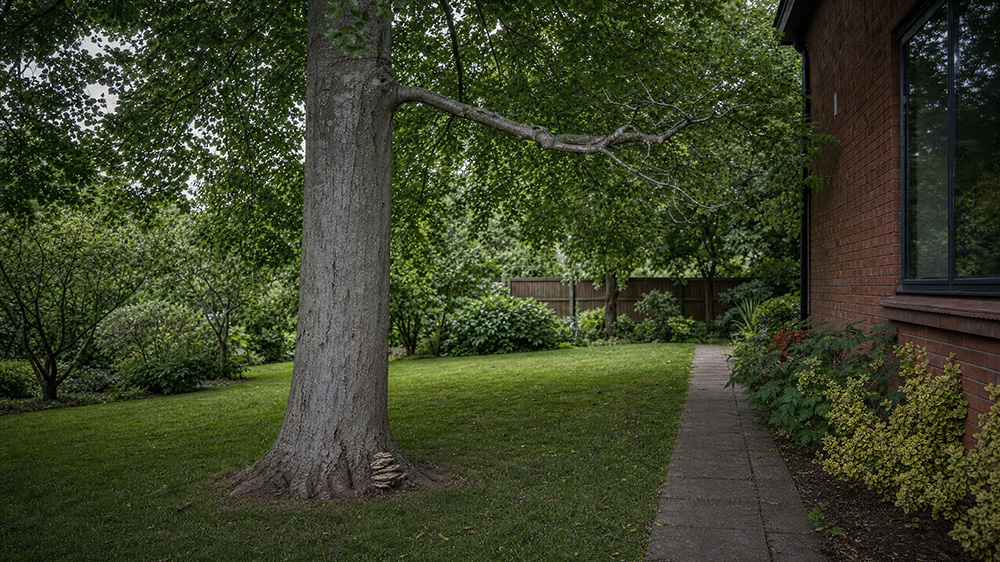
Fungal brackets growing at the base of a tree can be a sign of decay within the root system or trunk — though it's worth saying that not all fungi found near a tree indicate a problem. Some live harmlessly on dead material in the soil; others are a genuine signal of internal decay in the stem or roots.
This is one of the areas where a trained eye makes a real difference, since telling the difference isn't always straightforward from a photo or a quick look. The position of the fruiting body matters as much as the species.
What the Canopy Tells You From the Ground
You don't need to climb a tree to spot a problem. Thinning foliage, leaves noticeably smaller than in previous years, early autumn colour, or dieback concentrated at the top of the crown can all point to stress in the roots or the stem.
As a rough guide, if something approaching a quarter to a third of the canopy is showing no leaf during the growing season, that warrants a professional look rather than another season of waiting.
How We Actually Assess a Tree
A proper visual inspection is a staged process, and it follows an established method — Visual Tree Assessment, which reads the tree's own growth as evidence of how it has responded to stress over time. We start at the roots and root plate, work up through the stem, then out through the branch structure to the canopy, noting decay, cracking, deadwood, fungal growth, past damage, and reduced leaf volume.
That assessment weighs up three things together: how likely the tree or part of it is to fail, what's underneath it that could be affected, and how serious the consequences would be. A tree with a defect standing in the middle of an open paddock is a very different proposition to the same tree overhanging a patio. Where a risk needs quantifying rather than simply describing, structured systems such as Quantified Tree Risk Assessment exist to put numbers against it.
Any work that follows is carried out to BS 3998, the British Standard for tree work, which is what separates proportionate management from unnecessary cutting.
Where You Stand as the Owner
If a tree on your land causes injury or damage, the question asked afterwards is whether you took reasonable care. A tree owner is generally expected to act on defects that a reasonable inspection would have revealed — and "I didn't know" is a weaker position than "I had it inspected and acted on the advice".
That's the practical value of a documented assessment. It gives you a record of what was found, when, and what was recommended.
Concerned About a Tree on Your Property?
If you've noticed any of these signs, it's worth getting a professional opinion rather than waiting. Rogers & Cork Tree Care offers tree assessments across Leicester, Hinckley, Loughborough, Oadby, and the wider Leicestershire area. If you've got a tree you're not sure about, get in touch and we'll take a look. Free quotes, no obligation.