How Often Should Trees Be Pruned?
There's no single answer to how often a tree needs pruning — it depends heavily on its age, species, and how much energy it has available. Here's a practical breakdown.
Young Trees: Light, Regular Pruning
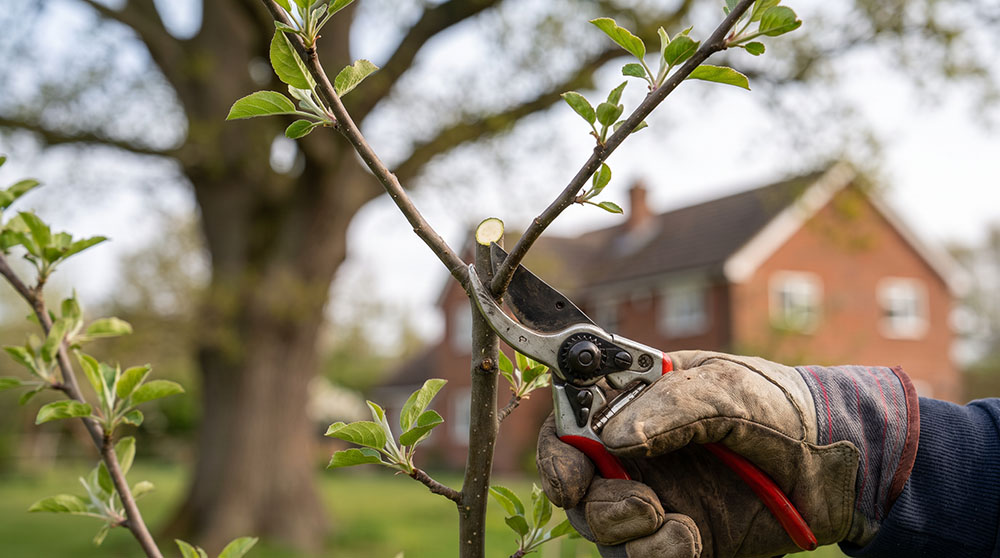
Young trees, roughly 10 to 15 years old, benefit from light formative pruning every few years. This is when a tree has the most energy available, and it's the best window to help establish a strong, well-balanced structure that will serve it well for decades.
Formative pruning at this stage is mostly about removing competing leaders, crossing branches, and narrow weak unions before they become structural problems. The cuts are small, the tree seals them quickly, and the work prevents far more drastic intervention twenty years later.
Established Trees: Little and Rarely
Once a tree is established and mature, heavy pruning should generally be avoided unless there's a clear reason for it. At this stage, work is usually only needed every three to five years, since the tree's available energy for recovery is reduced compared to when it was young.
Veteran Trees: Monitor, Don't Cut
For old or veteran trees, monitoring is often preferable to major pruning. Large cuts can do more harm than good on a tree in its final life stage, when energy reserves are low and recovery is slower. In many cases, the right approach is to keep an eye on the tree rather than intervene.
How Much Is Too Much in One Go?
This is where a lot of damage gets done. A tree's leaves are how it feeds itself, so removing a large proportion of the canopy at once takes away its means of recovery at exactly the moment it needs it most.
BS 3998, the British Standard for tree work, reflects this: crown thinning is normally specified as a modest percentage of the foliage, commonly not exceeding around 30 per cent, and reduction work is specified as a measured length of branch removal rather than "take a third off". Anything beyond that should have a specific justification behind it.
Species Makes a Real Difference
Fast-growing species like willow, poplar, and ash tend to need more frequent attention simply because they put on growth quickly. Slower-growing species — many oaks, beech, and yew among them — typically need far less frequent pruning once they're established.
Fruit trees are a category of their own. They usually benefit from a planned, often annual pruning routine, because the goal is balancing healthy growth against fruit production rather than simply managing size.
Conifers deserve a specific warning: most cannot regenerate from brown, bare wood. Cut back past the green and it will not grow back, which makes regular light trimming far more important for conifers than for broadleaved trees.
Mistakes That Come From Getting Timing Wrong
The most common problem is a tree that's outgrown its space because earlier, gentler management was missed — which then requires more drastic work that may not even be achievable without harming the tree.
Topping — cutting the top of a tree flat, or reducing major limbs back to stubs — is one of the most damaging practices there is, and it isn't recognised as good arboricultural practice. It leaves large wounds the tree struggles to seal, opening a route for decay, and it triggers a flush of fast-growing shoots that are only weakly attached. Those shoots then grow large and heavy on a decaying stem, which is precisely the combination that fails later.
Not Sure When Your Tree Was Last Pruned?
Rogers & Cork Tree Care carries out tree pruning across Leicester, Hinckley, Loughborough, Oadby, and the wider Leicestershire area. If you've got a tree you're not sure about, get in touch and we'll take a look. Free quotes, no obligation.